
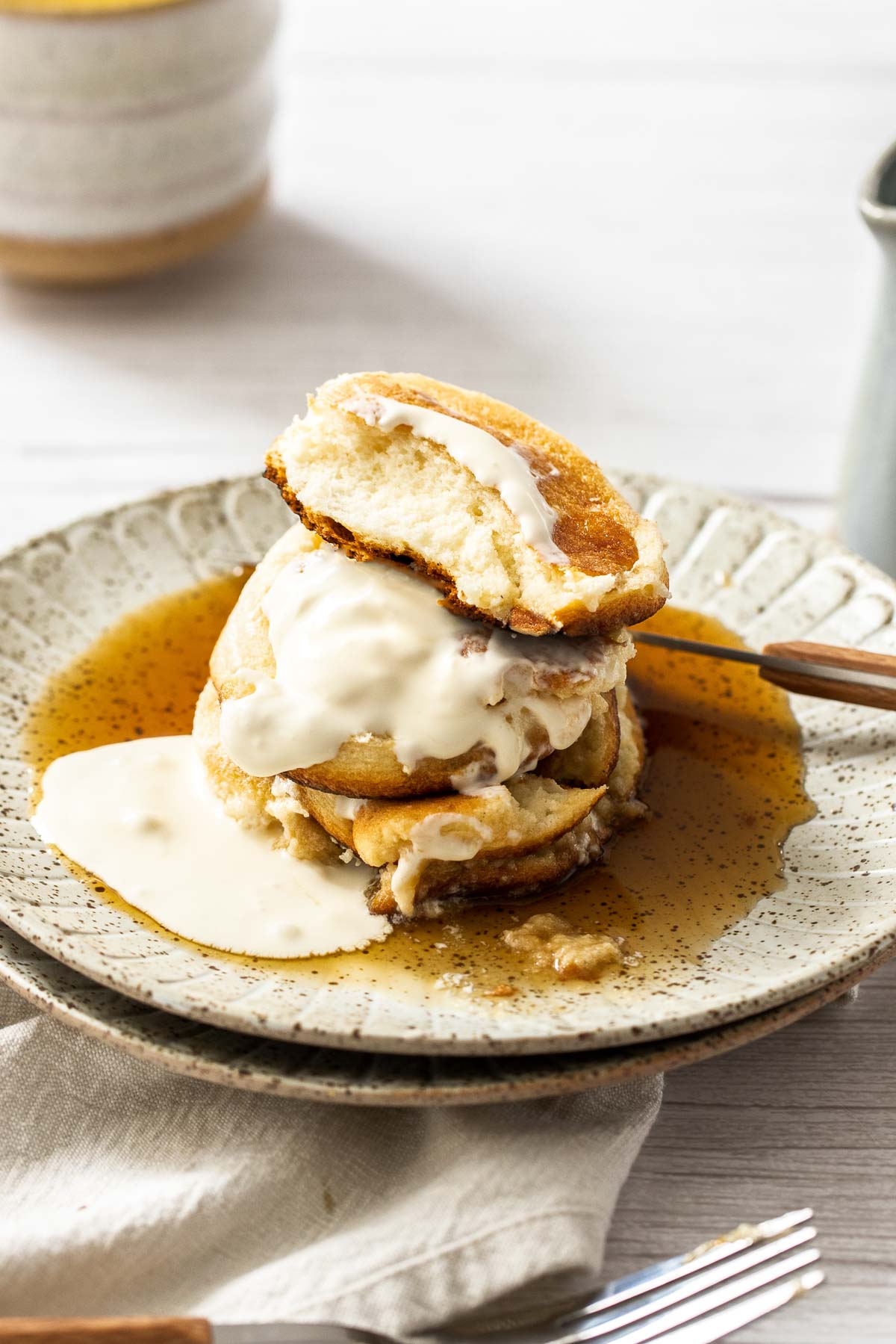
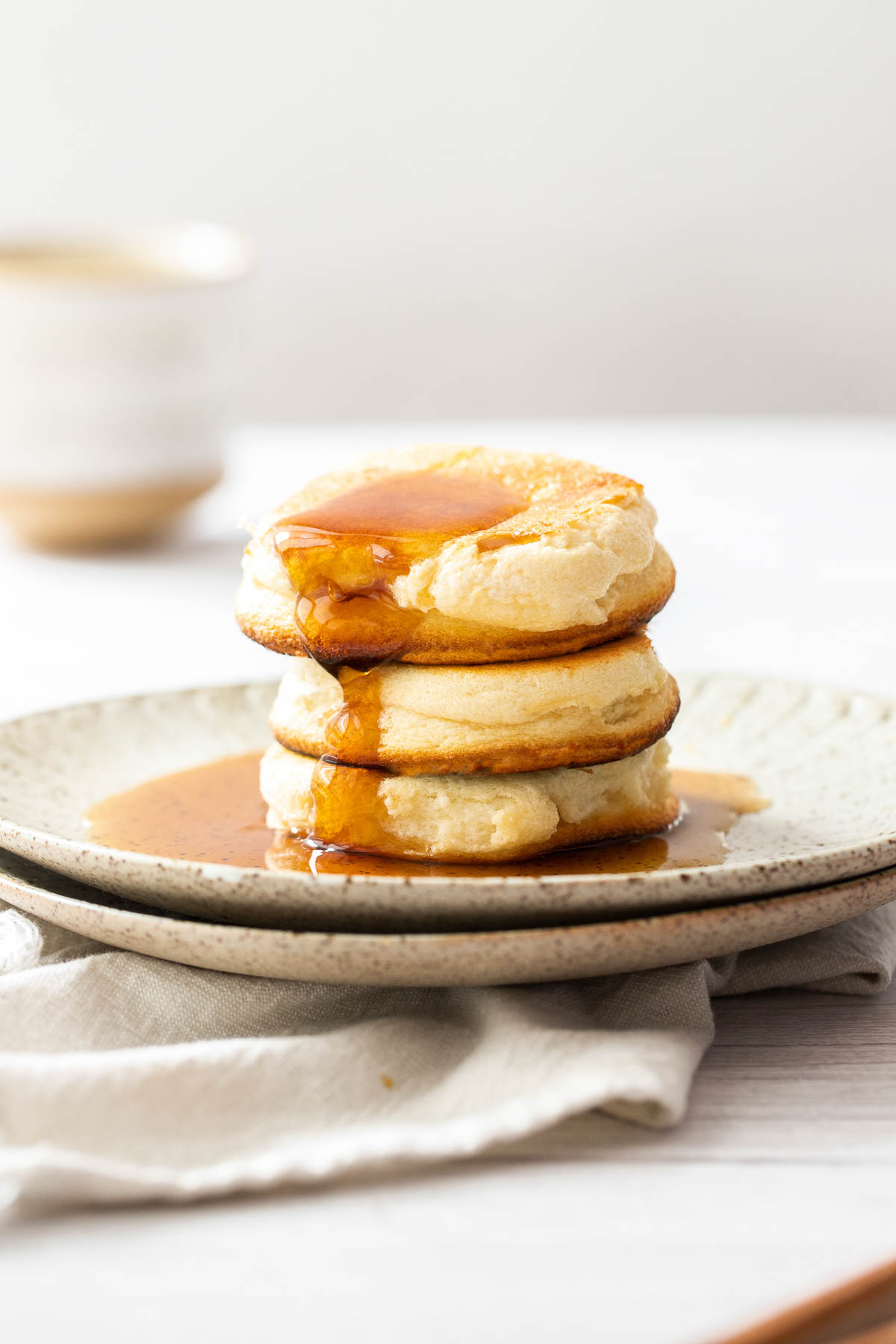
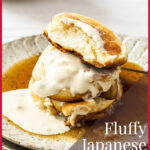
Fluffy Japanese Pancakes are tall, airy soufflé pancakes with a soft, cloud-like texture. This no-mold recipe uses whipped egg-white meringue for that signature rise, then cooks low and slow for gloriously fluffy pancakes. Serve them with maple syrup and whipped cream, fresh fruit, or my tiramisu topping.

Recipe Summary: Fluffy Japanese Pancakes Recipe
- Recipe Name: Fluffy Japanese Pancakes
- Equipment Needed: Electric hand mixer, large nonstick pan with a lid, spatula
- Ready In: 45 minutes
- Serves: 2
- Difficulty: Intermediate - the meringue and low-heat cooking technique take a little practice
- Main Ingredients: Eggs, cake flour, milk, sugar, baking powder, and vanilla
- Calories: 186 calories per serving
- Dietary Info: Vegetarian
- Why You’ll Love It: Tall, soft, cloud-like Japanese pancakes made without ring molds, with detailed tips to help you master the meringue, rise, and cooking temperature.
SUMMARIZE & SAVE THIS CONTENT ON
Jump to:
- Recipe Summary: Fluffy Japanese Pancakes Recipe
- What are Japanese Soufflé Pancakes?
- Key Ingredients
- Toppings & Variations
- How to Make Japanese Pancakes Without a Mold
- Riz's Expert Tips
- What I Learned Testing this Recipe
- Why do Japanese Pancakes Deflate?
- Japanese Pancake Recipe FAQs
- More delicious pancake recipes
- 📖 Recipe
- 💬 Reviews
What are Japanese Soufflé Pancakes?
Japanese soufflé pancakes are a modern café-style take on traditional pancakes, popularized in Japan during the 2010s. They’re taller, softer, and more jiggly than traditional blueberry buttermilk pancakes, with a delicate, soufflé-like texture thanks to the use of whipped egg whites.
Unlike Japan’s savoury okonomiyaki, these are sweet pancakes.
In Japanese, they’re often called fuwafuwa pankēki (ふわふわパンケーキ). Fuwafuwa describes something soft and fluffy - from pancakes to kittens!
Fun fact: I actually studied Japanese at university. I can also tell you, quite confidently, that I’m still pretty bad at it.
Key Ingredients

You only need a handful of ingredients to make Japanese soufflé pancakes, but a few of them do most of the heavy lifting:
- Eggs: Whipped egg whites create the pancakes’ height and airy texture, while the yolk adds richness.
- Cake flour: Keeps the pancakes soft and tender rather than chewy.
- Sugar: Adds sweetness while also helping stabilize the whipped egg whites.
- Baking powder: Provides a little extra lift alongside the meringue.
- Milk: Adds moisture and helps create a smooth batter.
- Vanilla: Adds a little warmth and sweetness to the flavor.
For another pancake recipe that uses whipped egg whites for extra lift, try my mascarpone pancakes. They’re a little more forgiving than Japanese pancakes but still wonderfully airy.
Toppings & Variations
Keep it classic with whipped cream, maple syrup, fresh berries, or a dusting of powdered sugar.
For an easy tiramisu-inspired topping, dust ¼ cup whipped cream with 1 teaspoon espresso powder, drizzle with 1 teaspoon melted dark chocolate, and swirl together. Or try my tiramisu pancakes for the full experience!
Fancy something fruitier? My Japanese mango pancakes incorporate mango into the batter, while the homemade blueberry compote from my lemon ricotta pancakes makes a lovely topping here, too.

How to Make Japanese Pancakes Without a Mold
You don't need ring molds to make tall Japanese soufflé pancakes. The edges won't be quite as perfectly straight, but the trick is to build the batter upward rather than letting it spread outward.

- Make the batter. Prepare the egg-yolk mixture, then whip the egg whites into the meringue.

- Fold gently. Fold the meringue into the yolk mixture just until combined. Take care not to knock out the air.

- Start cooking. Place a mound of batter into a lightly greased pan over low heat and cover with a lid.

- Build the height. Once the batter begins to set, add another scoop directly on top. Cover and continue cooking slowly.

- Flip very gently. Once the underside is set enough to hold together, carefully turn the pancake over. Oh. So. Gently.

- Finish and serve. Cook until the center is set, then serve immediately with your favourite toppings.
Riz's Expert Tips
1. Master the Meringue
The meringue is the most important part of this recipe - and probably the trickiest if you don't make meringue often.
- Keep the egg whites cold until you're ready to whip them.
- Use a clean, dry bowl. Even a little grease or egg yolk can make it harder for the whites to whip properly.
- Stop at the right stage. The meringue should look glossy and hold a firm peak, with perhaps just the very tip bending over. If it looks dry, grainy, or clumpy, you've gone too far.
- Cream of tartar is optional. I don’t find it necessary, but you can add ⅛ teaspoon per egg white to help stabilize the meringue.
2. Cook Low and Slow
Patience is the key here, bestie. Keep the heat low so the center has time to cook before the outside gets too dark. Higher heat may give you beautifully browned pancakes on the outside…with a raw middle. Nobody has ever asked for their pancakes medium-rare.
Keep the pan covered while they cook to hold in heat and moisture and help the centers set.
3. Flip Gently
No high-flying pancake acrobatics! Wait until the underside has set, then use a wide, flat spatula to turn it over gently. A rough landing can knock out some of that precious air.
What I Learned Testing this Recipe
Japanese soufflé pancakes are a little more temperamental than my popular fluffy pancake recipe, but they’re absolutely achievable at home!
After testing this recipe, I discovered that you don’t need ring molds to make beautifully tall pancakes. I also experimented with adding water to the pan to create steam, but didn’t find that it made a noticeable difference.
And don’t be discouraged if your first batch isn’t perfect. These pancakes take a little practice! You'll sometimes see Japanese pancake recipes promising perfect results in 15-20 minutes, but in my experience, that's optimistic for most home cooks.
Why do Japanese Pancakes Deflate?
If your pancakes deflate - or never rise very much in the first place - don't panic. Japanese pancakes are notoriously temperamental, and small changes in the meringue or cooking temperature can make a big difference.
The two biggest things to check are:
Your meringue. Underbeaten egg whites won't have enough structure to support the pancakes, while overbeaten meringue can become dry and difficult to fold into the batter without losing air. Aim for glossy peaks that hold their shape with just a slight bend at the tip. I use an electric hand mixer to beat the egg whites. You're very welcome to use your impeccably toned whisking muscles, it's a good workout! In fact, I'd join you…except, *disappears*
Your cooking temperature. Keep the heat low. Higher heat can make the pancakes rise quickly and brown on the outside before the center has fully cooked. If the interior hasn't set enough to support that height, the pancake is much more likely to collapse once it comes off the heat.
A little deflation after cooking is normal. What you're trying to avoid is a dramatic collapse or a pancake that never develops much height in the first place.
Japanese Pancake Recipe FAQs
No. This recipe is specifically designed to make fluffy Japanese pancakes without ring molds. The trick is to add the batter in layers, building upward rather than letting it spread outward. Your pancakes may not have perfectly straight sides, but they can still rise beautifully.
The outside should be lightly golden, with the center set and no wet batter inside. If the pancakes are browning too quickly before the middle cooks through, lower the heat and continue cooking with the lid on.
Japanese soufflé pancakes get most of their height from whipped egg-white meringue folded gently into the batter. The trapped air expands as the pancakes cook, creating their characteristic tall, soft, cloud-like texture.
Store leftovers in an airtight container in the refrigerator for up to 2 days. Reheat gently in a 200°F (95°C) oven until warmed through. I don’t recommend freezing them, as their delicate soufflé texture doesn’t thaw particularly well.
More delicious pancake recipes
Pancake recipes are kinda my shtick. Here are some other recipes I know you'll love:


📖 Recipe
Fluffy Japanese Pancakes (Soufflé Pancakes)
- Total Time: 45 minutes
- Yield: 2–3 fluffy Japanese pancakes 1x
- Diet: Vegetarian
Description
Tall, airy Japanese soufflé pancakes with a soft, cloud-like texture. This tested recipe uses whipped meringue for its signature rise and can be made without ring molds.
Ingredients
Bowl 1 – Yolk Mixture
- 1 egg yolk
- 2 tbsp sugar
- 2 tbsp milk
- ½ tsp pure vanilla extract
- 3 tbsp cake flour
- ½ tsp baking powder
Bowl 2 – Meringue
- 2 large egg whites
- 1 ½ tbsp sugar
Instructions
Make the Yolk Mixture
- Whisk the yolk. Whisk the egg yolk and sugar until pale and frothy. Mix in the milk and vanilla.
- Add the dry ingredients. Sift in the cake flour and baking powder, then whisk just until incorporated.
Make the Meringue
- Whip the egg whites. Using an electric hand mixer, beat the egg whites until pale and frothy. Gradually add the sugar in batches while continuing to beat.
- Check the meringue. Stop when the meringue is glossy and holds a firm peak, with just the tip bending slightly. Avoid whipping until it looks dry, grainy, or clumpy.
Combine & Cook
- Combine the mixtures. Whisk one-third of the meringue into the yolk mixture until incorporated. Gently mix in half of the remaining meringue, then fold in the rest with a spatula, taking care not to deflate the batter.
- Start cooking. Heat a large nonstick pan with a lid over low heat and add a very small drizzle of oil. Spoon ¼ cup of batter into the pan. Cover and cook for 2-3 minutes.
- Build the height. Spoon another ¼ cup of batter directly on top of the partially cooked pancake. Cover again and cook for another 4-5 minutes.
- Flip gently. Once the underside is set enough to hold together, carefully flip the pancake. Cover and cook for another 4-5 minutes, or until the center is cooked through. Repeat with remaining pancake batter and serve. Enjoy!
Notes
Expect a little practice. Japanese soufflé pancakes can be finicky, especially the first time. Meringue consistency and low cooking heat make the biggest difference.
Water isn’t necessary. Some methods add a tablespoon of water to the pan to create steam. I tested this and didn’t find that it noticeably improved the pancakes.
Cook one at a time if needed. I usually cook these individually in a large covered pan. A covered griddle also works.
Ring molds are optional. You can use one for straighter sides and a more uniform shape, but this recipe is designed to work without them.
- Prep Time: 20 minutes
- Cook Time: 25 minutes
- Category: Breakfast & Brunch
- Method: Stovetop
- Cuisine: Japanese
Recipe Testing & Updates: This Japanese pancake recipe was originally published on March 28, 2019 – the recipe has remained unchanged. I’ve since updated the post with new photos, a recipe video, clearer instructions, and troubleshooting tips to help you make these pancakes successfully.



Lizrdee
My son and I made these since he had been asking for a japanese themed breakfast for a few weeks in anticipation of a trip to Japan. We made 3X the batch and since we were cooking them one a time the batter started to separate over time. Initially I was just using the top later (the fluffy part) but eventually I had to start mixing it and after that all the pancakes were flat. Any tips to prevent the separation? Still delicious though and he was very happy.
Riz
Hi there! That’s a tough one I’m afraid. Japanese pancakes (by their very nature) are a bit finicky. An occasional stir will prevent that separation from occurring but it will take away from how fluffy the pancakes get as well. I know a lot of restaurants (at least, here in Toronto) that cook bigger batches, but they tend to use very large griddles (to cook several at a time) as well as pancake molds (to help make the pancakes fatter).
Hope that helps a bit!
PM Higgins
I DID IT!!!
I’ve been trying to do this using the TASTY RECIPES one for weeks and FAIL FAIL FAILING! But I tried this version and success on the first shot! And they turned out even better the second time!!!
THANK YOU!
My wife has promoted me to PM of our house!
BEST REGARDS
PM Higgins
Rich Lai
Can you just multiply the ingredients by what ever number you need to yield, or do you recommend doing this recipe in batches?
Riz
Hi Rich,
I’ve not tried cooking these in large batches but I would imagine you should be fine to multiply the ingredients by whatever number you need to yield 🙂
Shaunda
Can you use an egg substitute, like egg beaters for less cholesterol?
Riz
Hi Shaunda,
I’ve not tried this…but my guess would be no. This is a bit of a finicky type of pancake to make. The reduced fat content of the substitute likely wouldn’t be ideal. I’d be interested in knowing how it turned out if you did use a substitute though 🙂 Good luck!
sydney
I just attempted these and they stuck like crazy to the pan! 🙁 I oiled the pan before hand, any idea why this could’ve happened?
Riz
Hi Sydney,
Pancakes usually stick to pans for one of two reasons: 1) the pan has residue (so this could be leftover food from a previous cook, or an old pan that has lost its smoothness etc) or 2) The heating distribution is off (the pan might not be hot enough, or it may not heat evenly). Hope that helps!
Fran
I was making the meringue with 3x servings and i think i overmixed it. However it was already runny from the beginning, i followed the steps exactly and my meringue turned out runny right away before me reaching a stiff peak phase 😞 they just look like regular pancake withh holes, sad it turned out this way. I read somewhere if you are in a humid place it affects the consistency of the batter. My country is super humid and today in particular was very hot, could that be the contributing factor despite my kitchen not being so hot? At least that’s how I felt 😞
Riz
Hi Fran,
The humidity could be the issue – it could also be overmixing, or an issue with the meringue (which can be very finicky). I’d recommend going through the details in the post to see if anything rings true for you. Good luck!
Heather H
I did it! I did it!!! I had trouble with my first one (it brkoe!) but then all the rest turned out beautifully!!! I’m so excited! Thank you!!!
Riz
Yessss!!! So happy to hear this Heather!!
MissChef
Unfortunately mine (first attempt) were not as fluffy (maybe 1cm thick). When i poured the second layer it spread till beyond the first layer instead of clumping up on top of it. I didn’t know when to stop beating the egg whites, after 5min, still barely peaks that i just stopped at some point thinking i must be overbeating it already. Also i made my own cake flour mixing all-purpose with cornstarch. Taste-wise though it’s great. I’ll try again next time, will tag you when it’s perfect. Thanks for sharing!
Riz
Glad you enjoyed them, MissChef! Japanese pancakes can be a little bit finicky, but keep practicing you’ll get the hang of them soon. (And in case it’s not something you’ve done in the past, I’d recommend checking out some basic tutorials on how to make a meringue – that will help!)
Riz
Cakesbylynnzw
Tried this recipie today. My husband woke up feeling like pancakes and had never made pancakes before. (I know, how dare I) but tried these and OMG are they amazing. They came out perfectly!!!
Riz
I’m so happy to hear that!! Wishing you and your husband many more delicious pancake breakfasts!
Anna
Mine burned, was the gas on too high? Or what?
Riz
Hi Anna – yes, the heat was likely too high. These ones are a bit delicate!
Gerri Hunter
These pancakes are awesome I made them for my twin granddaughters and the loved them
Thank You
Riz
Hi Gerri, YOU’RE awesome! And I’m super happy to hear you and your twin granddaughters enjoyed this Japanese Pancake recipe!
Happy Holidays!
Riz
Karen
This was my 4th try at fluffy pancakes and it was a success!! The first time the pancakes came out wonderfully fluffy, probably more by chance than anything else! Cream of tartar,? Nope. Steaming? Nope. But I lowered the heat to 3 (1-9 ceramic top) and covered. Bingo! Can’t wait to make these for my grandsons next Christmas! Thank you!!
Riz
Woohoo!!! Wishing you a delicious Japanese pancake Christmas!!
Djabrina
They were perfect until I delicately transfered them to my plate : prrrrrrt ! Bye bye air… they became flat under my eyes @$!%€ ! Maybe they weren’t cooked enough ?
So close, will definitely try again. And even if they became flat, the taste is simply delicious !
Riz
Oh no!! I’m not sure how they were transferred (they’re delicate little things so they have to be moved gently!) as they shouldn’t be significantly deflating once off the heat, but I’m glad you still enjoyed them !!
AK
Tried these after almost giving up on making soufflé pancakes from trying so many recipes
And these turned out perfect!
I finally made it, all thanks to your clear and helpful tips and recipe
Super yum, and super super light! Loved it! Thank you!!
Riz
AK! I am SO SO happy to hear this. Wishing you many delicious pancake breakfasts in the future!! (And please do share a photo of your pancakes with me on Instagram if you’d like!)
Ashley
can I sub cake flour for all purpose?
Riz
Hey there Ashley – yes, you can but your Japanese pancakes won’t be quite as fluffy or airy (they’ll still be fairly fluffy though!)