
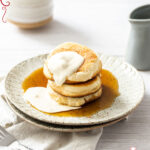
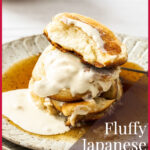
Fluffy Japanese Pancakes are a soft, airy cotton candy-like pancake dream come true. Dress them up in whipped cream, rain down the maple syrup, or try out the tiramisu topping recipe I provide – they come out delicious every which way!
"Souffle pancake" recipes can be tricky, but once we're done here bestie, you'll be able to spark joy…one outrageously fluffy pancake at a time.
Jump to:
- …I finally made Fluffy Japanese Pancakes
- What are Japanese Pancakes / Souffle Pancakes
- How to make Japanese Pancakes (without a mold)
- 3 Secrets to making perfect Japanese Pancakes every time
- Why do my Japanese pancakes deflate
- How to make the Tiramisu Souffle Pancake topping
- Storage suggestions
- Other delicious pancake recipes
- Fluffy Japanese Pancakes, Updated
- Helpful tools
- 📖 Recipe
- 💬 Reviews

…I finally made Fluffy Japanese Pancakes
Pancake recipes make up four of my ten most popular recipes. And one of the most requested recipes over the last year has been for fluffy Japanese pancakes – how to make them, and how not to mess them up!
And if you've ever tried this custardy clouds-on-a-plate breakfast, you'll know why! (It's because they're delicious.) But as you may have figured out, they're a bit finicky to master. They're often called souffle pancakes, after all!
(As a rule, souffle-anything is probably code for "delicious…but temperamental".)
Don't give up too easily though, we're going to walk through the main things to keep in mind when you're making this style of pancake, and then with a little practice, you can serve up the most gloriously airy and fluffy Japanese souffle pancakes to someone very special.
A Note:
While researching this recipe, I came across A LOT of posts suggesting that their Japanese pancake recipe can be made with ease and abandon in a mere 15-20 minutes.
I'm going to tell you frankly that unless you're a culinary professional, cooking in a pre-prepped restaurant-style kitchen, that's simply not the case.
Regardless of whether you choose to use my recipe (or someone else's), please don't be discouraged if your Japanese pancakes don't come out as fluffy and airy the first time you try.
This is a recipe that sometimes requires a little practice, and a little patience. But it's certainly achievable for anyone cooking at home. (I mean, even *I* got it right…eventually.)
Of course, if you do get stumped somewhere, you may want to check out my guide on How to Read a Recipe.
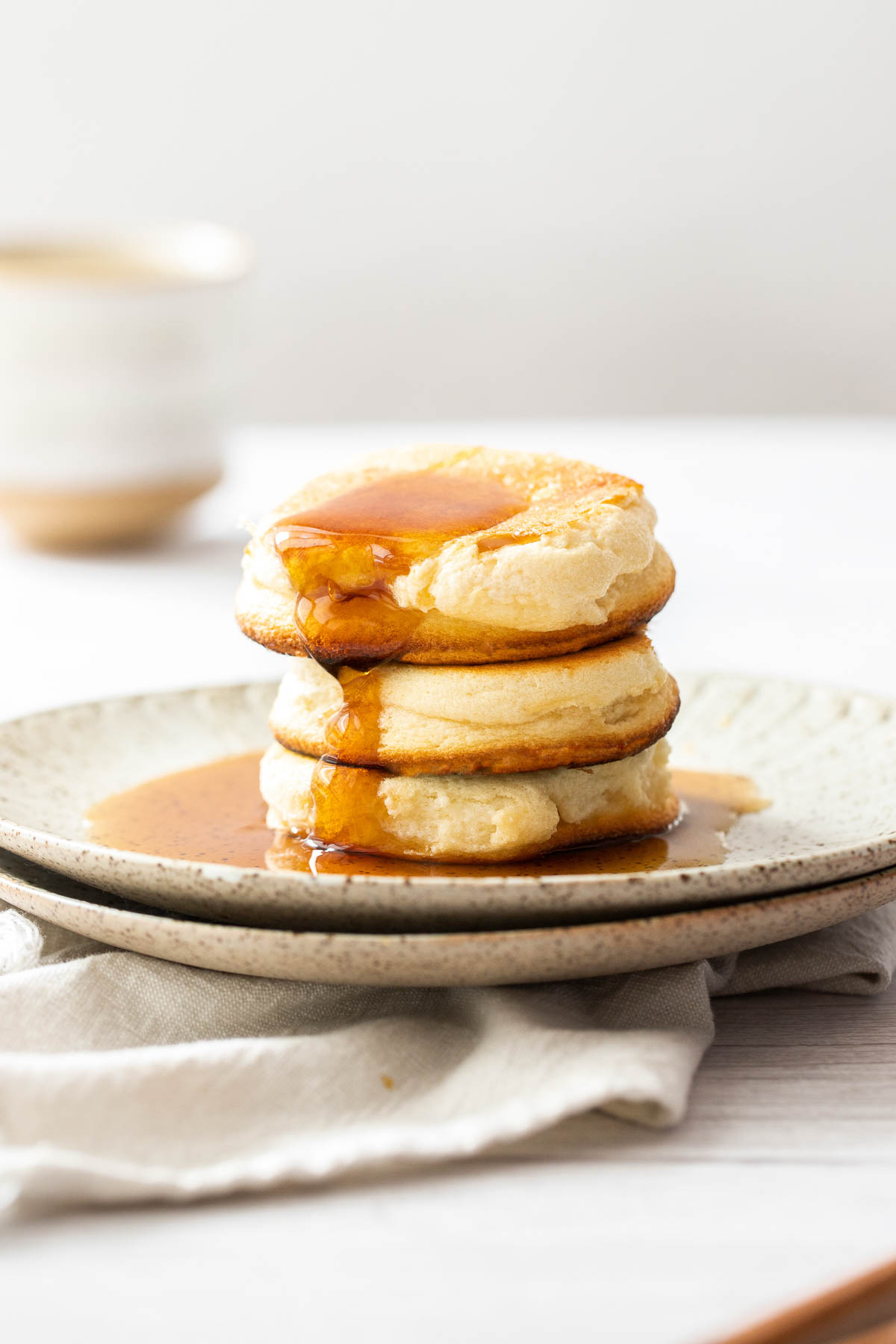
What are Japanese Pancakes / Souffle Pancakes
Japanese Pancakes, often called Souffle Pancakes, are similar in ingredients, but different in composition and texture to your standard pancake recipe.
Exceptionally thick, airy and soft…they are perfectly fluffy pancakes! The major difference between them and regular pancakes is the smaller amount of flour, and that the egg whites are beaten to form a meringue (just like you would in a souffle, hence the name), before being gently folded into the rest of the pancake batter.
As a result, more air bubbles form inside the pancake batter, and these bubbles are able to hold their shape better. The result is a super fluffy and airy pancake. Seriously, it’s like biting into a cloud!
And in case you're wondering what the word for pancakes are in Japanese, the answer is "pankeki" (パンケーキ). And "fuwafuwa" (ふわふわ) is a mimetic word used to describe fluffy/soft/airy things…from pancakes to kittens! So, yes - we're making fuwafuwa pankeki today!
Fun Fact: I actually studied Japanese at university. And I can tell you quite confidently, that I'm really quite bad at it.
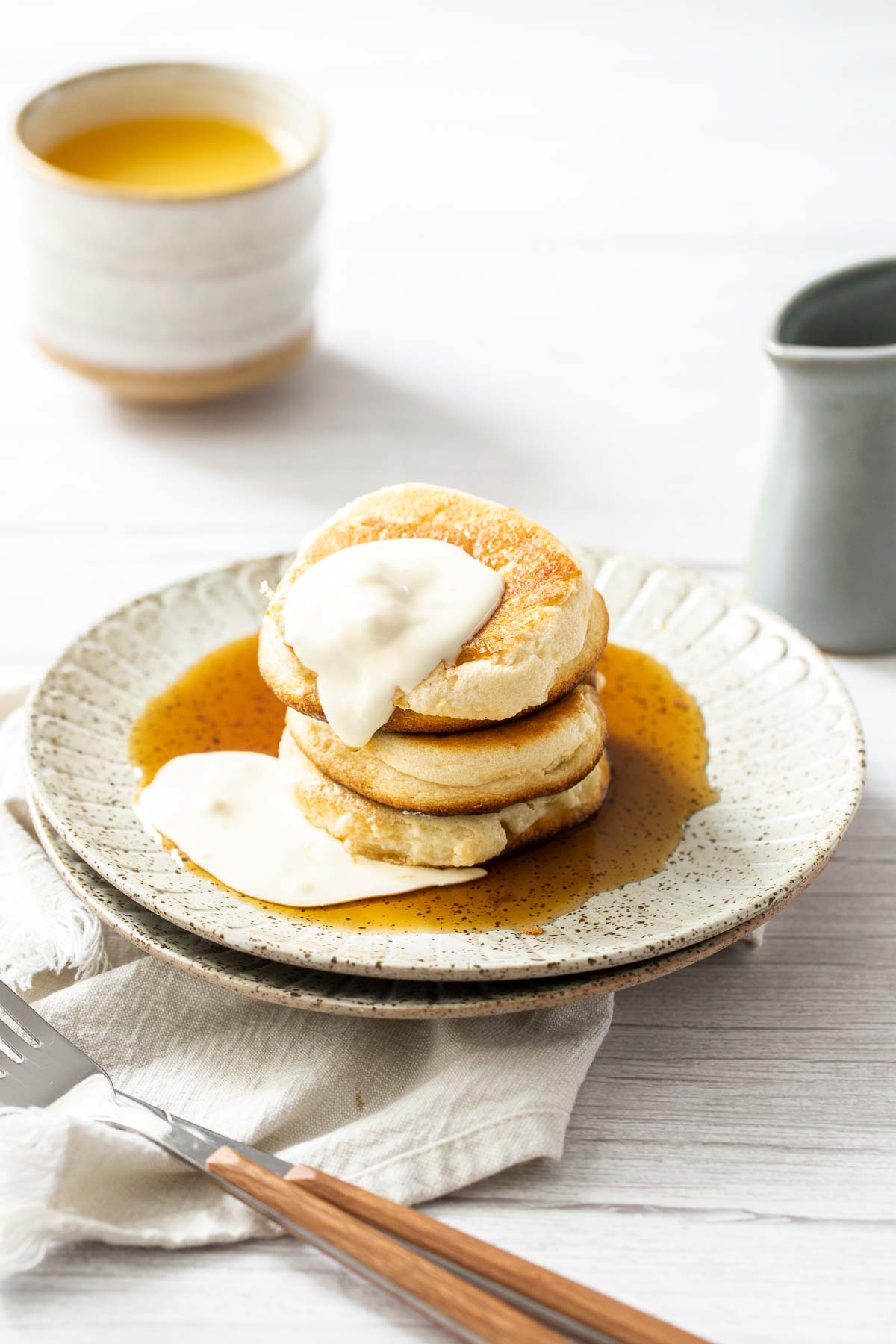
How to make Japanese Pancakes (without a mold)
A lot of people have asked me if you how to make souffle pancakes without a mold. The answer is: it takes a little practice. Of course, your pancakes won’t have the super straight edges that a mold provides; a mold makes it easier to stack the pancakes higher too.
- Prepare. Prepare your yolk mixture and whip your meringue.
- Combine. Combine the meringue and the yolk mixture, being being careful not to over-mix, in order to create your pancake batter.
- Cook. Over a low heat, add a dollop of the batter. Cover the pan. As it begins to cook, pile some more batter on top. Cover again.
- Flip. Oh. So. Gently.
- Serve. Icing sugar, whipped cream, maple syrup – all work great!
3 Secrets to making perfect Japanese Pancakes every time
1. Master the Meringue
If you don't have much experience making meringue, then this will likely be the hardest part. Honestly, this could be an entire post by itself, so I'm going to give you a few key things to keep in mind.
- Keep the separated egg white refrigerated until you come around to whisking it.
- Make sure your bowls are clean and dry. Any sediment or leftover moisture (even just water) can hurt your meringue.
- Know when to stop mixing the meringue. You want the whipped meringue to hold its peak…more so than a soft peak, but it shouldn't be a super stiff peak. (Overmixing very slightly won't destroy your pancakes, but it will mean slightly less fluffiness.)
- You can use cream of tartar to help stabilise the meringue. I personally don't think it's necessary here, but if you choose to go in that direction, add ⅛ teaspoon cream of tartar for each egg white in your meringue.
2. Cook ‘Em Low & Slow
Like so many things in life, patience is the key here, bestie. Japanese pancakes need to be cooked slowly with the heat on low. Higher heats will result in the outsides getting cooked, while the inside remains raw. Nobody ever says, "I like my pancakes cooked rare".
Make sure to cover the pan to lock in all that lovely moisture too.
3. Flip Gently, Bestie
No high-flying death-defying pancakes flips here (or ever…if fluffiness is your goal). Delicately turn the pancake over using a flat spatula/flipper. The harsh impact from a careless flip will literally squish the air bubbles in your pancakes!
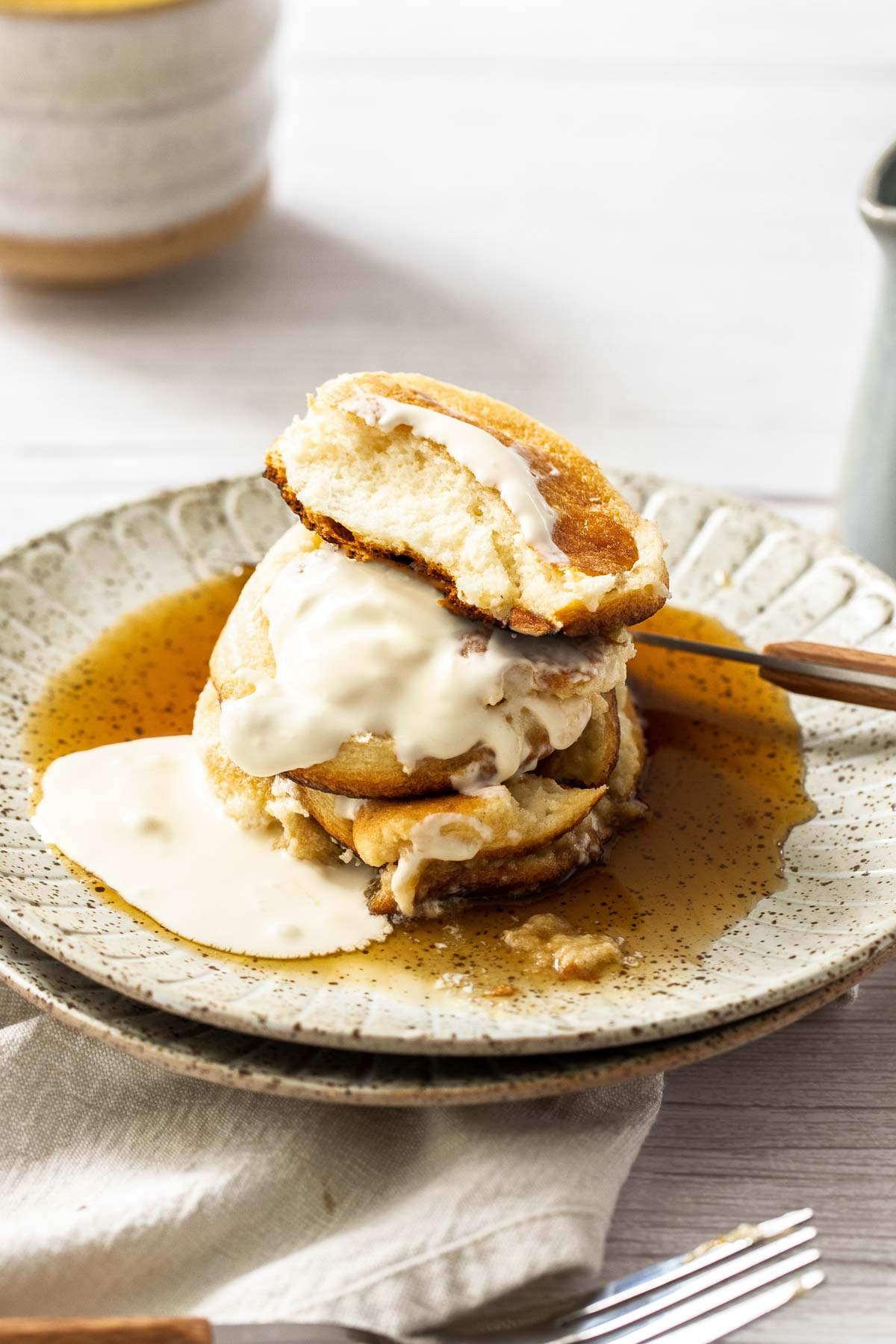
Why do my Japanese pancakes deflate
If your Japanese souffle pancakes have deflated (or just failed to rise), don’t worry. You’re not alone…it’s happened to the best of us. Sometimes despite doing everything right, it can still happen. However, there are a couple of key points to note to make sure your Japanese pancakes don’t deflate:
Be careful not to over or under beat your egg whites. This can be a bit tricky, you want to mix in air bubbles which will create structure (and fluffiness!) in your pancakes, but if you overdo it, you end up destroying that very structure.
Heat management when cooking your pancakes. There’s often a temptation to use a higher heat when cooking (as it causes a quicker rise). However, the outside of your pancakes also cook quicker and may brown before the internal pancake has had a chance to cook through enough to hold its tall fluffy structure.
How to make the Tiramisu Souffle Pancake topping
I made a tiramisu souffle pancake variation of this recipe. But if you don’t feel like the couple of extra steps required for that recipe, here’s an easier version:
Simply dust a ¼ cup of whipped cream with 1 teaspoon of espresso powder, drizzle on a teaspoon of melted dark chocolate, and then give it a little swirl. Ta-da! Souffle Pancakes with a fancy (but totes easy) tiramisu topping.
Actually, that’s one of the best things about these Japanese pancakes – they go with a lot of different toppings - whipped cream, fruits (I recommend making mango pancakes), and maple syrup work great; powdered sugar is popular too; custard and cream? Yup, still yummy.

Storage suggestions
Japanese pancakes can be stored in an airtight container for up to two days. To reheat, I recommend setting your oven to 200 degrees F, placing your pancakes on a try, and warming them up slowly.
Can you freeze Japanese pancakes
No. The souffle pancake texture doesn’t thaw well.
Other delicious pancake recipes
Pancake recipes are kinda my shtick. Here are some other recipes I know you'll love:
- Fluffy, Fluffy Pancakes (No buttermilk version)
- Lemon Mascarpone Pancakes
- Strawberry Cheesecake Pancakes
- Blueberry Buttermilk Pancakes
- Lemon-Raspberry Dutch Baby Pancake
Fluffy Japanese Pancakes, Updated
This recipe was originally published on March 28th, 2019. I’ve given it an update to add more information, prettier photos, and a snazzy little recipe video! The recipe is the same as it’s always been, but I hope that the more detailed post helps anyone who finds themselves struggling at making what many consider to be the finickiest type of pancake!

Helpful tools
The link below is an affiliate link. This means that if you choose to purchase using it, I will receive a small commission, at no extra cost to you. And that would be very lovely of you. Thank you for supporting Chocolates & Chai!
I used an electric hand mixer to beat the egg white into a meringue. You're very welcome to use your impeccably toned whisking muscles, it's a good workout! In fact, I'd join you…except, I don't wanna.
What's your favourite type of pancake? What kind of toppings do you like? Tell me in the comments below.
📖 Recipe
Fluffy Japanese Pancakes
- Total Time: 45 minutes
- Yield: 2–3 fluffy Japanese pancakes 1x
- Diet: Vegetarian
Description
Fluffy Japanese Pancakes (aka. Japanese Souffle Pancakes) are an airy pancake dream. Light, fluffy, and an experience you’ll long to eat again. Time to spark a little joy…one fluffy souffle pancake at a time!
Ingredients
Bowl 1 – Yolk Mixture
- 1 egg yolk
- 2 tbsp sugar
- 2 tbsp milk
- ½ tsp pure vanilla extract
- 3 tbsp cake flour
- ½ tsp baking powder
Bowl 2 – Meringue
- 2 large egg whites
- 1 ½ tbsp sugar
Instructions
Bowl 1 – Yolk Mixture
- Whisk the egg yolk with the sugar until pale and frothy. Mix in the milk and vanilla.
- Sift flour and baking powder into the mixture and whisk until incorporated.
Bowl 2 – Meringue
Whip the eggs white using an electric mixer (or a tireless whisking arm) until pale and frothy, begin adding the in sugar in batches until a glossy meringue is formed. You want stiff-ish peaks, not STIFF-peaks.
Combine
- Whisk ⅓ of the meringue into the yolk mixture until completely incorporated. Add half of the remaining meringue and mix delicately. Add the remaining meringue and fold into the mixture using a spatula - be careful not to deflate the batter.
- Heat a large non-stick pan (with a lid) over low heat. Add a very small drizzle of oil. Using ¼ cup scoops, scoop the batter into the pan. Cover and cook for 2-3 minutes.
- Remove the lid, add another ¼ cup of batter on top of the pancake already cooking. Cover and continue to cook for another 4-5 minutes.
- Flip the pancake…EVER. SO. GENTLY! Cover and cook for 4-5 more minutes until done. Repeat with the remaining batter. Serve!
Notes
- Getting these to be perfect is honestly a little bit finicky. If it doesn't work out for you the first time, don't lose heart. It takes time and a little patience to get these Fluffy Japanese Pancakes to come out just right!
- I've seen tips online suggesting you add a tablespoon of water to your pan to add even more moisture to the pancakes. I only tried this once, but personally didn't see a difference.
- I cook these one pancake at a time in a large pan. In Japan, they’re often cooked on a griddle with a lid. Either option is fine.
- You can use a ring mold if you want to ensure an thickness and shape. I personally like the asymmetry that comes from working without a mold!
- Prep Time: 20 minutes
- Cook Time: 25 minutes
- Category: Breakfast & Brunch
- Method: Stovetop
- Cuisine: Japanese



Pidgeon
Made these with Trader Joe’s gluten free pancake mix instead of flour. Cut the sugar to 1 tbs with the yolk. The mix already has some sugar and baking powder so only added vanilla. The secret is in the meringue. They puffed up perfectly on my pancake griddle. a light coating of butter worked better than oil. the first one stuck when I tried to turn it. Turning them is tricky, takes a couple or more times to get the hang of it. I got 4 pancakes out of the recipe. My sloppy turning wasn’t pretty but they tasted yummy. Didn’t even need syrup.
Riz
Ah, that’s good to hear…and thanks for including your modifications – I’m sure it’ll be helpful to anyone that wants to try this using the same pancake mix! You’re right, the flip can be a bit finicky, but a little practice and you’ll have it down!
snuggles and tea
Awesome recipe and so easy to follow! Just tried it and shared my experience linking your recipe! 🙂
Riz
Oh! Thanks so much for trying it out, I’m super happy to hear you liked it!!! (And thank you for linking back to the recipe!)
Andrea
Is cake flour the secret to this recipe? I wonder if I can sub in all purpose flour. Thanks!
Riz
Hey Andrea, cake flour is recommended as it will make a lighter pancake. But if you’re in a pinch, you can still get pretty good results with all-purpose flour. Good luck!
pancake heaven
like, actually, heavenly.
Riz
LOL! Thank you! I’m so happy you enjoyed it!
Riz
Heather P Van Gorder
Used pineapple can as ring – took a few tries to figure out how to flip (using two spatulas finally did the trick). Fluffy & delicious!! Thanks for the recipe!!
Riz
Hey Heather! Good idea using the pineapple can as a ring! And well done flipping it! I’m really happy it worked out so well for you!! Hope you come back soon, and try out a few of my other recipes too 🙂
Nora
I’ve made this recipe twice now. They’re incredibly light & fluffy and they taste amazing!
Saved the recipe and they’re the only pancakes I’ll ever make from now on. Awesome recipe!
Riz
I’m so happy to hear that Nora!! Hopefully you’ll share some photos of your pancakes with me on Instagram, or try a few other recipes too 🙂
Kris
I am going to try these tomorrow! After trolling recipes online I am happy to find what looks to be the traditional recipe without using a pre-made pancake mix and form molds! Thank you so much and I look forward to feeding them to my picky husband
Riz
I hope they turned out perfectly Kris!!!
Jen
Hello
Could I use almond milk at all? 🙂
Riz
Hi Jen! I’ve not tried it myself…and generally, almond milk isn’t a perfect baking substitute for regular milk. However, since this recipe only uses a small amount, I think it should work out okay 🙂 Let me know how it went!
tim
you listed sugar twice?
Riz
Hey Tim! Well spotted…sugar is listed twice because it’s used in Bowl 1 for the Yolk Mixture stage, and Bowl 2 for the Meringue stage. I’ve amended the recipe to clear that up. Thanks!
Heather
Can these be prepared in advance and warned up later?
Riz
Hi Heather,
Technically, yes. (But for the best results, no…the airiness/texture will be lost. I’m afraid this style of pancake is quite finicky.) If preparing in advance, I’d suggest only preparing the batter, and then cooking the pancakes when you intend to eat.
Soroush
Hi Riz. I have made it today for the first time and it was amazing except the part that I overcooked it and it became less fluffier than it could be. Thanks a lot
Cameron
OMG. <333333 They turned out SO WELL. YOUR INSTRUCTIONS ARE THE BEST!
Riz
Thanks so much Cameron!!! I’m happy to hear the instructions were clear for you!!!
Sean Standage
My batter was runny so they looked more like regular pancakes, were my whites not stiff enough?
Thanks
Riz
Hey Sean! That sounds like it could have been the case, you may have overmixed the batter which is a common problem! Hope you’ve managed to solve it since 🙂
Sara
Following and pinning for later. Can’t wait to taste this…I love a good challenge, especially when the reward is a belly full of pancakes:)
Riz
Hi Sara! So glad you passed by, hope you enjoy the pancakes! (I know you’re more than up to the challenge!)
C.J
Where do you incorporate the vanilla?
Riz
Oops! Sorry about that CJ! You add the vanilla in at the same time as the milk. I’ve edited the recipe to include that, thanks for noticing and letting me know!
Jo Vanderwolf
I’ve often seen these and have been dying to try them. They do sounds a little scary to try and make though. I’m pinning this to try when I am feeling more confident! lol Thanks for sharing 🙂
Riz
Good luck!! And don’t be nervous. You got this, Jo!
Jane
Do you need to add any cream of tartar or acid in this recipe?
Riz
Hi Jane – nope, not required 🙂
Chef Sous Chef
I love Japanese pancakes. Looking forward to having these on the weekend!
Riz
Woohoo! I hope you enjoyed them!
Riz
I hope you enjoyed them!